


Author’s Prefatory Note:
This article contains discussion of sensitive issues and topics. The author is especially sensitive to the feelings and sympathetic to the experiences of those who have suffered the horrific tragedy of losing a child. This article’s focus is theological, however; therefore, certain editorial preferences — namely for truth and candor — have been made. Please exercise discretion in your reading of and any responses to this material. Thank you.
Special thanks to Dr. Gregory Bottaro and the CatholicPsych Institute for publishing the blog article that inspired me to write this piece.
Questions Explored in This Article include:
How does Catholic teaching on Original Sin and Baptism explain the mystery of Baby Brian’s incorrupt body?
What does the Church say about the fate of infants who die unbaptized, or only receive a conditional baptism?
Does the phenomenon of incorruptibility in an infant point to extraordinary Divine Mercy at work beyond the sacraments?
How does the traditional notion of Limbo compare with the Church’s more recent emphasis on hope in God’s universal salvific will?
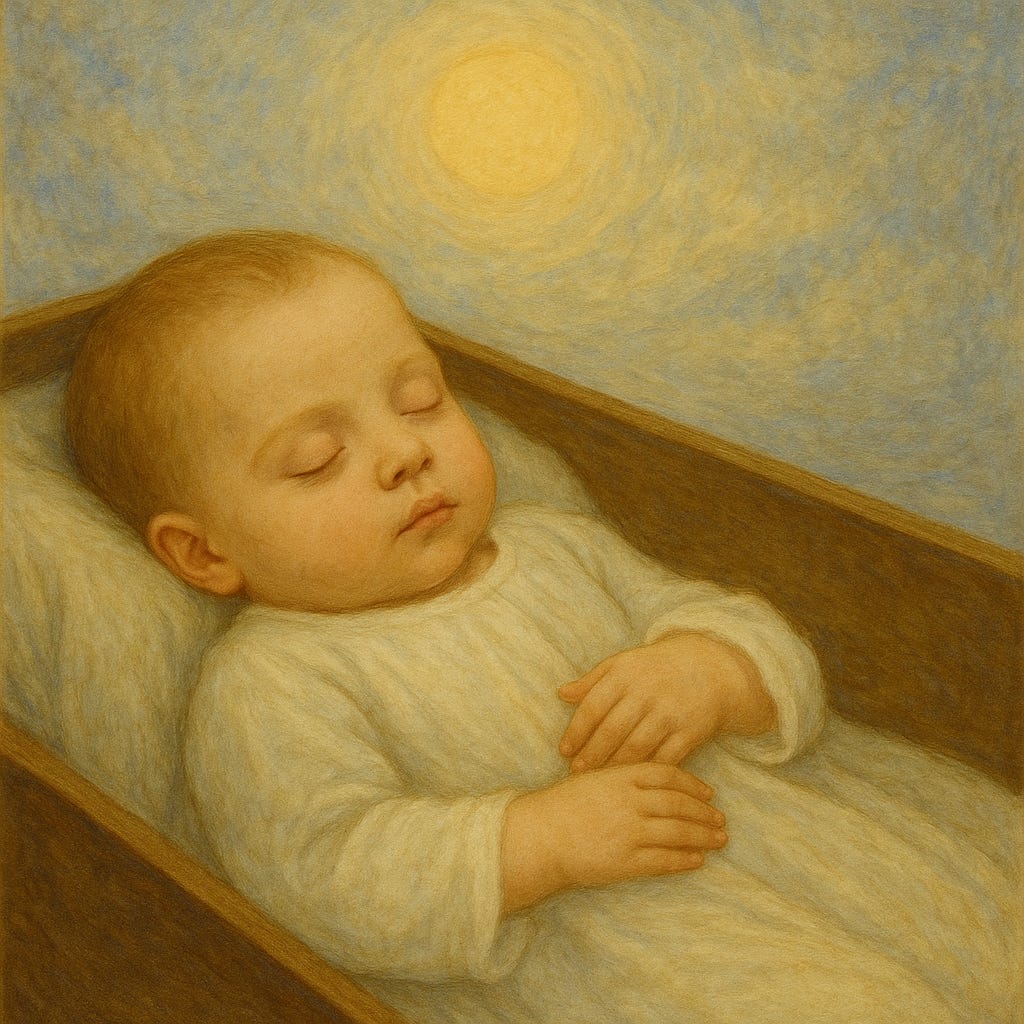
The astonishing story of Baby Brian, a newborn who died minutes after birth in 1982 and whose body was found incorrupt 37 years later, has captured hearts and imaginations. Catholic media report that when Brian’s casket was reopened in 2019, “his body was entirely intact: lifelike in color and form… supple skin, fully intact facial features”, with “no decomposition” (Baby Brian Project, 2025; Quackenbush, 2025). His mother described him as looking “just this perfect baby, like we had just buried him that day” (Baby Brian Project, 2025; Quackenbush, 2025). Such preservation defies normal decay and has been called a “miracle” by those who witnessed it (Cruz, 1991).
Importantly, it was later discovered that Baby Brian had not been baptized before his death. Though his grieving parents had requested a priest at the time of his birth, no record of baptism existed. Hospital notes confirmed instead that a priest had performed a conditional baptism about 35 minutes after the infant was pronounced dead (Baby Brian Project, 2025; Quackenbush, 2025). In Catholic practice, a conditional baptism (sub conditione) is administered when there is doubt whether the sacrament has already been validly received or whether the subject is still alive at the time; the priest baptizes with the formula, “If you are able to be baptized, I baptize you…” (Catechism of the Catholic Church [CCC], 1997, §1284).
Yet this event raises profound theological questions: how can an unbaptized (or only conditionally baptized) infant be honored by such a sign? Does it reflect extraordinary Divine Mercy? Does it mean unbaptized (or conditionally baptized) infants might go to Heaven instead of the old idea of Limbo? To answer, we must carefully review Catholic teaching on original sin and infant salvation, and trace the development of the Limbo hypothesis, always with full fidelity to Tradition.
Original Sin and Baptism: What the Church Teaches
The Catholic Church has always taught that all humanity inherited Original Sin from Adam (CCC, 1997, §§404–405). Every person is born “in Adam as one body” and thus born with original sin, a deprivation of original holiness. This means even infants, though innocent of personal fault, lack the sanctifying grace that Adam once had (CCC, 1997, §405). Baptism is the ordinary sacrament Christ established to cleanse that Original Sin and restore grace: “Baptism… imparts the life of Christ’s grace [and] erases original sin and turns a man back towards God” (CCC, 1997, §405). Indeed, the Church teaches that “Baptism is necessary for salvation for those to whom the Gospel has been proclaimed… the Church has always held the firm conviction that [it] is necessary for salvation” (CCC, 1997, §1257). All Catholic parents know the Church’s plea: “Let the children come to me,” and so the faithful seek to have even newborns baptized soon after birth, so that Christ’s grace washes over them and incorporates them visibly into the Body of Christ (CCC, 1997, §1261).
All are born with Original Sin: Catholic doctrine (Council of Trent, 1546/1851; Denzinger) holds that the sin of Adam has been transmitted to all, so every human (even infants) is “a sinner from his mother’s womb” (Council of Trent, 1546/1851).
Baptism removes Original Sin: The sacrament of Baptism “erases original sin” (CCC, 1997, §405) and infuses grace. In effect, an infant who is baptized is reborn in Christ and welcomed into heaven (Catholic Church, 1997, §§404–405).
God’s mercy and extraordinary situations: The Church also acknowledges that “God has bound salvation to the sacrament of Baptism, but he himself is not bound by his sacraments” (CCC, 1997, §1257). Thus, theologians note that in extraordinary cases God could apply Christ’s saving grace in ways beyond the ordinary ritual (for example through baptism of desire or baptism of blood) (Catholic Church, 1997, §1257; International Theological Commission, 2007).
Baptism of desire: Tradition (e.g., St. Cajetan, 16th c., cited in theological literature) teaches that even the desire for baptism by loving parents can suffice for grace if the child dies before receiving it. So a baby in his mother’s womb, held in a mother’s prayers and wishes, may already be joined in spirit to baptism’s effects (Catholic Church, 1997; International Theological Commission, 2007).
Catechism’s hope: Today’s Catechism explicitly entrusts unbaptized infants to God’s mercy and “allow[s] us to hope that there is a way of salvation” for them (CCC, 1997, §1261). The Church teaches that “the great mercy of God…desires that all men should be saved”, and Jesus’ love for children – “Let the children come to me” – give us confidence there can be a path to salvation even if baptism was impossible (Catholic Church, 1997, §1261).
In short, traditional teaching affirms both the necessity of baptism and the boundless charity of God who can apply Christ’s redemption in special ways. God is free to do wonders beyond the measure of the sacraments, yet He has given us Baptism as the ordinary channel of grace (Catholic Church, 1997, §1257).
The Limbo Hypothesis in Church History
What then of the old idea of Limbo of the Infants – the notion that unbaptized babies, while innocent of personal sin, could not enter the Beatific Vision? Limbo was never a defined dogma of the Church. It arose as a theological speculation to reconcile God’s justice with His mercy. Early and medieval theologians offered various views:
St. Augustine (4th–5th c.): Augustine fiercely opposed Pelagius, insisting all share in Adam’s guilt and so require Christ’s grace. He held that an unbaptized infant dies “in a state of sin” and therefore cannot see God without baptism (Augustine, Against Julian, ca. 5th cent./trans. Schaff, n.d.). Augustine famously denied any happy middle-place of rest: “he denied the existence… of some middle place of rest and happiness” (Augustine, Against Julian; see scholarly translations). At the same time, he wondered at the fate of these innocents. In Contra Julianum he admitted that such children would suffer “the lightest condemnation of all,” though he could not specify its nature (Augustine, Against Julian, trans. Schaff, n.d.).
Pope Innocent III (1201): Innocent taught that original sin alone is not punished with fire but with the loss of the Beatific Vision (see historic magisterial sources compiled in Denzinger).
St. Thomas Aquinas (13th c.): Aquinas developed the idea that limbo is a state of natural happiness without the Beatific Vision. He described unbaptized infants as residing on the “outmost fringes of Hell,” meaning they are outside God’s grace, but deserving of no personal punishment (Aquinas, Summa Theologiae, Suppl. Q71, a.7; Aquinas, 1274/1947). “They died without the grace of God… but they were not worthy of punishment,” he wrote, arguing such souls would feel no sorrow since they would lack knowledge of what they had lost (Aquinas, 1274/1947).
Later teachers: Over the centuries many held to something like Aquinas’ picture. In 1905 St. Pius X promulgated a Roman catechism (intended for Rome only) stating flatly, “Children who die without Baptism go to Limbo, where they do not enjoy God, but neither do they suffer” (Catechism of St. Pius X, 1905/ed. translations). However, this was never taught as a worldwide magisterial definition.
Second Vatican Council and after: By the mid-20th century theologians began to move away from limbo. The 1980 Instruction on Infant Baptism reaffirmed that the Church “can only entrust [unbaptized infants] to God’s mercy, as she does in the funeral rite provided for them” (Sacred Congregation for the Doctrine of the Faith, 1980). The 1992/1997 Catechism of the Catholic Church omits any mention of Limbo, and instead emphasizes hope for salvation (CCC, 1997, §1261). Most recently, in 2007 the International Theological Commission (ITC) published “The Hope of Salvation for Infants Who Die Without Being Baptized.” With papal approval, it concluded that while Limbo remains a possible theological opinion, it is no longer the focal point. Instead, it encourages trust in God’s universal salvific will (ITC, 2007).
In short, over time Catholic teaching has developed from dwelling on Limbo to stressing confident hope in God’s mercy.
Divine Mercy and the Fate of Infants
The Catholic tradition leaves ample room for God’s miraculous mercy. Even in theory, theologians have posited ways unbaptized children might share in Christ’s redemption:
Conformity to Christ’s Suffering: An innocent infant who dies could be said to share in Christ’s own death and resurrection in a mystical way.
Baptism of Blood (Martyrdom): Like the Holy Innocents, a child who dies through violence may receive the graces of martyrdom (ITC, 2007).
Baptism of Desire or Pure Grace: God can apply the merits of baptism even without the water and words (CCC, 1997, §1257).
Interpreting the Incorruptible Child
How does Baby Brian’s case fit into all this? First, the facts matter: Catholic sources report that Brian did receive baptism, albeit conditionally, soon after death (Baby Brian Project, 2025; Quackenbush, 2025). His parents had asked for it at birth, and hospital notes later confirmed the priest baptized him 35 minutes after he was pronounced dead (Baby Brian Project, 2025; Quackenbush, 2025). The parents’ hope rests on “conditional baptism” – performed even when he might have been dead – to have effectively washed away his Original Sin. If such a baptism were validly performed, Brian could be said to be, by Catholic teaching, an infant reborn in Christ’s grace.
In orthodox terms, there would be no theological puzzle if a baptized child were to pass away, for the incorruption of his body could be seen as a sign of God’s care for him (Cruz, 1991).
But what if he had not been, or was not, validly baptized? Would that contradict Church teaching? Not at all. In Catholic theology, God is free to operate beyond our normal expectations (CCC, 1997, §1257). The Church explicitly prays that He will find “a way of salvation for children who have died without Baptism” (CCC, 1997, §1261). So an incorrupt body of an unbaptized child could simply be seen as a powerful sign of God’s mercy – an extraordinary grace (ITC, 2007; Catholic Church, 1997).
Ultimately, the incorruptibility of this infant’s body does not force any change in doctrine. Rather it serves as an invitation to gaze with wonder at the mystery of God’s love.
References
Baby Brian Project. (2025). Baby Brian: A pilgrim of hope [Website]. Retrieved June 2025, from https://www.babybrian.org/ 
Quackenbush, R. (2025, June 27). Exclusive | ‘Like we had just buried him that day’: Catholic mother finds her infant son’s body in extraordinary state 37 years after his death. CatholicVote. https://catholicvote.org/exclusive-catholic-mother-finds-infant-sons-body-in-remarkable-state-after-37-years/ 
Cruz, J. C. (1991). The incorruptibles: A study of incorruption in the bodies of various saints and beati (Rev. ed.). TAN Books. (Original work published 1977).  
Catholic Church. (1997). Catechism of the Catholic Church (2nd ed.). Libreria Editrice Vaticana. https://www.vatican.va/archive/ENG0015/_INDEX.HTM 
Sacred Congregation for the Doctrine of the Faith. (1980, October 20). Instruction on infant baptism (Pastoralis actio). Vatican. https://www.vatican.va/roman_curia/congregations/cfaith/documents/rc_con_cfaith_doc_19801020_pastoralis_actio_en.html 
International Theological Commission. (2007, April 19). The hope of salvation for infants who die without being baptized (with papal approval). Vatican. https://www.vatican.va/roman_curia/congregations/cfaith/cti_documents/rc_con_cfaith_doc_20070419_un-baptised-infants_en.html 
Catholic News Agency. (2023, May 25). What is incorruptibility? Here’s what you need to know. https://www.catholicnewsagency.com/news/254416/what-is-incorruptibility-here-s-what-you-need-to-know (B. Brockhaus, author). 
Council of Trent. (1546/1851). Decree concerning Original Sin (Session V). In Canons and Decrees of the Council of Trent (T. A. Buckley, Trans.). Retrieved from https://en.wikisource.org/wiki/Canons_and_Decrees_of_the_Council_of_Trent/Session_V/Original_Sin 
Aquinas, T. (1274/1947). Summa theologiae (Supplement, Q. 71, a. 7) (Fathers of the English Dominican Province, Trans.). Christian Classics. Retrieved from https://www.ccel.org/ccel/aquinas/summa.XP_Q71_A7.html 
Augustine. (ca. 5th century/1957). Against Julian (Contra Julianum) (trans. R. J. Deferrari or Philip Schaff). Retrieved from Nicene and Post-Nicene Fathers / CCEL: https://www.ccel.org/ (see translations of Against Julian).  
Denzinger, H. (Ed.). (compilation). Enchiridion symbolorum (compendium of conciliar and papal declarations). (See Council and magisterial citations in standard editions). Available in English translations and historical collections (e.g., Denzinger, various eds.).